A complete, detailed guide

How to Write a
Pidyon Nefesh

Everything you need to know — the meaning, preparation, formula, and every halachic and traditional detail.

Definition

What is a Pidyon Nefesh (Pan)

Pidyon Nefesh — abbreviated Pan — is a letter of blessing request that a Chassid presents to his Rebbe. The word "Pidyon" comes from the language of redemption and exchange — to exchange the bad for good through the intervention of the Tzaddik.

The Pan has a dual and deep meaning: on one hand, it is a request for blessing and help — both material and spiritual. On the other hand, it is a soul connection of the requester to the Rebbe — a deep spiritual bond created by the very act of writing and submitting.

Special times

When to write a Pan

A Pan can be written at any time — but there are times when the custom is especially heightened:

1
Erev Rosh Hashana
The primary and central time for submitting Pans. At 'Kahal' — the second day of Rosh Hashana — thousands of Pans were submitted to the Rebbe by hand.
2
Chassidic dates
19 Kislev, 12 Tammuz, 3 Tammuz, 10 Shvat — occasions when the connection to the Rebbe intensifies and Pans are submitted.
3
Birthday
One's birthday is a personal time of divine favor — a fitting time for self-reflection, requesting, and renewing the connection with the Rebbe.

"Write to me about everything, including good news" — the Lubavitcher Rebbe

Before you begin

Preparation before writing

1
Washing hands
Wash your hands before writing the Pan — an act of purity and intention.
2
Writing after prayer
The recommended time is after the morning prayer, when a person is already in a state of intention and connection to holiness.
3
Making a good resolution
The Rebbe instructed to include in the Pan — or to decide in one's heart — a good resolution in some area. The "resolution" creates a "vessel" through which the blessing can take effect.
Without a resolution — the 'vessel' is missing
In Chassidic teaching, a blessing needs a 'vessel' — a place to rest in. Making a good resolution (even a small one) creates that vessel.
Writing guidelines

How to write the Pan

1
A clean white page
Write on a clean white page, preferably one side only.
2
Write in ink — pen
Write in ink (pen), not pencil. The writing should be as clear and legible as possible.
3
Open with the accepted formula
Begin with the accepted Pan formula (see below), and then write the request in personal language.
4
Material and spiritual requests
You may include any type of request — health, livelihood, a match, children, success in studies, spiritual matters.
5
Sign with your name
End with your signature — Hebrew first name + mother's name.
The formula

How to write a Pan — the accepted formula
פ"נ
אנא לעורר רחמים רבים על [שמכם] בן/בת [שם האם]
Then continue to write the personal request in your own words.
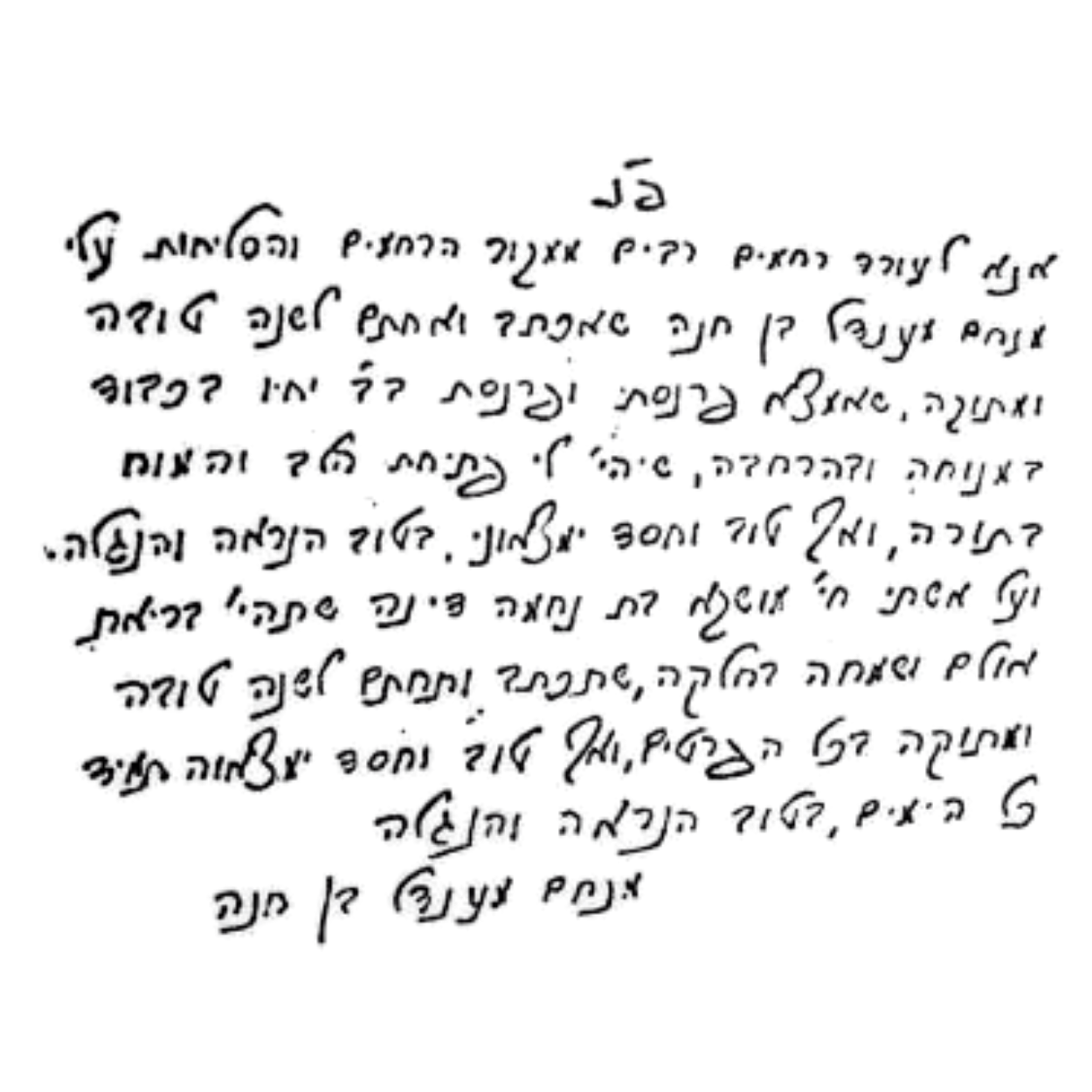
For example — a Pan written by the Rebbe himself to the Previous Rebbe
A Pan written by the Rebbe to the Previous Rebbe
The Pan written by the Lubavitcher Rebbe to the Previous Rebbe — the Rebbe Rayatz
Why not write 'I'?
Chassidim customarily do not write 'I' in a Pan — as writing 'I' symbolizes the ego. Instead of 'I request', one writes 'Please arouse mercy upon [name]' — in third person.
Name format

How to write the name

The name written in the Pan is always the Hebrew name only — followed by: the mother's name (not the father's).

Male
יצחק בן שרה
Female
מרים בת שרה

Write a Pidyon Nefesh to the Rebbe

"The more detail, the more praiseworthy" — the Lubavitcher Rebbe

Write a Pan  ←